Skip to content

Breaking barriers for deaf sport

UK Deaf Sport's chief executive officer explores the results of our latest Active Lives Surveys and explains their programme to create inclusive and accessible opportunities for deaf children and young people to get active.

29th May 2026

by Chris Ratcliffe
Chief executive officer, UK Deaf Sport

Growing up as the only deaf person in my family, sport became my escape from the loneliness and isolation I often felt at home and at school, because constantly second-guessing conversations and struggling to keep up takes a toll.

But sport gave me freedom and a way to let go of all that frustration.

It all started with swimming. In the water I found my own bubble of silence. No worrying about misheard words or asking people to repeat themselves – just me, the lane and a sense of independence.

That feeling is something every child should have, but for many deaf children the chance to experience it simply isn’t there.

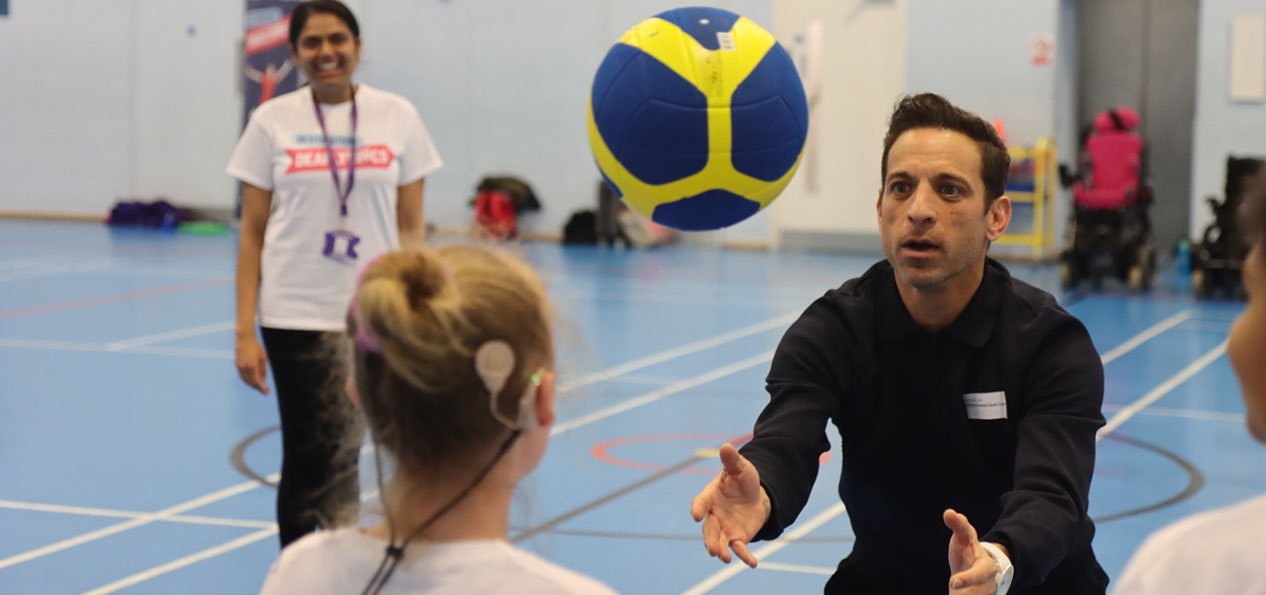
A girl wearing a hearing device passes a ball with a coach on an indoors court under the supervision a woman holding a folder.

The reality we don’t talk about enough

Deafness is often called 'the forgotten disability' and it’s easy to see why.

According to data by the National Deaf Children’s Society there are more than 18 million deaf and hard of hearing people in the UK, including 54,000 children, yet the challenges they face go far beyond communication.

Social isolation is common and that often leads to mental health struggles and inactivity.

The results of Sport England’s Active Lives Surveys painted a stark picture:

  • 51% of deaf adults are inactive, compared to 20% of non-disabled adults
  • 38% of inactive deaf adults don’t take part in sport at all, compared to 10% of inactive non-disabled adults
  • among less active children, 36% of deaf children do no activity at all, compared to 27% of non-disabled children.

These numbers support why tackling inequalities isn’t just a nice idea – it’s essential – and it’s exactly what Sport England’s strategy is all about.

There are more than 18 million deaf and hard of hearing people in the UK, including 54,000 children, yet the challenges they face go far beyond communication.

Destination Deaflympics: turning inspiration into action

In 2025, we launched Destination Deaflympics, a programme for 8-16-year-olds inspired by the Tokyo 2025 Deaflympics.

For us it’s all about giving young people the chance to try fun, inclusive activities and closing the gap between deaf children and their hearing peers.

So far we’ve reached 3,500 deaf and hard of hearing children across 175 settings and, along the way, we’ve learned a lot about the barriers they face, like the lack of accessible community provision or coaches who don't know how to deliver inclusive sessions.

That’s why we’re working with partners like the British Association of Teachers of Deaf Children and Young People to make sure deaf children get their recommended 60 minutes of activity every day.

This work has seen great success in the education sector with teachers sharing that by taking part in Destination Deaflympics, they are also seeing benefits in the classroom with students being more focused and ready to learn.

Role models who make a difference

The Deaflympics celebrated its 100th anniversary in 2024 and the Tokyo Games was an event like no other.

The GB team brought home 12 medals, finishing 12th out of 80 nations, but its impact went way beyond the results.

These athletes are key role models who showed what’s possible and inspired the next generation of Deaf sport men and women.

Before the Games, one of our swimmers spent a day with deaf schoolchildren in Greater Manchester sparking excitement and ambition that will last a lifetime.

Why this matters for Sport England’s vision

Everything we’re doing supports Sport England's long-term strategy, Uniting the Movement. We're talking about things like:

  • tackling inequalities by addressing the participation gap in sport for deaf people
  • creating inclusive environments through coach education and community partnerships
  • improving mental wellbeing by using sport to combat isolation
  • building role models who inspire young people to dream big.

Sport should be for everyone and that’s why, by breaking down barriers and creating opportunities, we’re not just changing lives – we’re helping deliver Sport England’s vision of a fair, inclusive and active nation.


Find out more

UK Deaf Sport

Sign up to our newsletter

You can find out exactly how we'll look after your personal data, but rest assured we'll only use it to make sure you receive our newsletter, to understand how you interact with our newsletter, and to provide administrative information about our newsletter.